Oxaide
Method layer

Knee-point and RUL framing for BESS review that needs to survive real decisions

The real predictive-maintenance question is not whether someone can draw a trendline. It is whether the battery is still degrading gracefully or moving into an accelerated regime that changes augmentation, warranty, dispatch, and downside planning.

Predictive-maintenance framing

Knee-point matters because acceleration risk changes the commercial answer, not because it sounds scientific

The right public posture is to show how slow-health evidence identifies regime change and intervention timing without pretending to know an exact replacement month. That is what a serious independent forensic layer should look like.

Dataset anchor

Oxford Battery Degradation Dataset

Evidence reference

Oxford Knee Point Rul

Why it matters

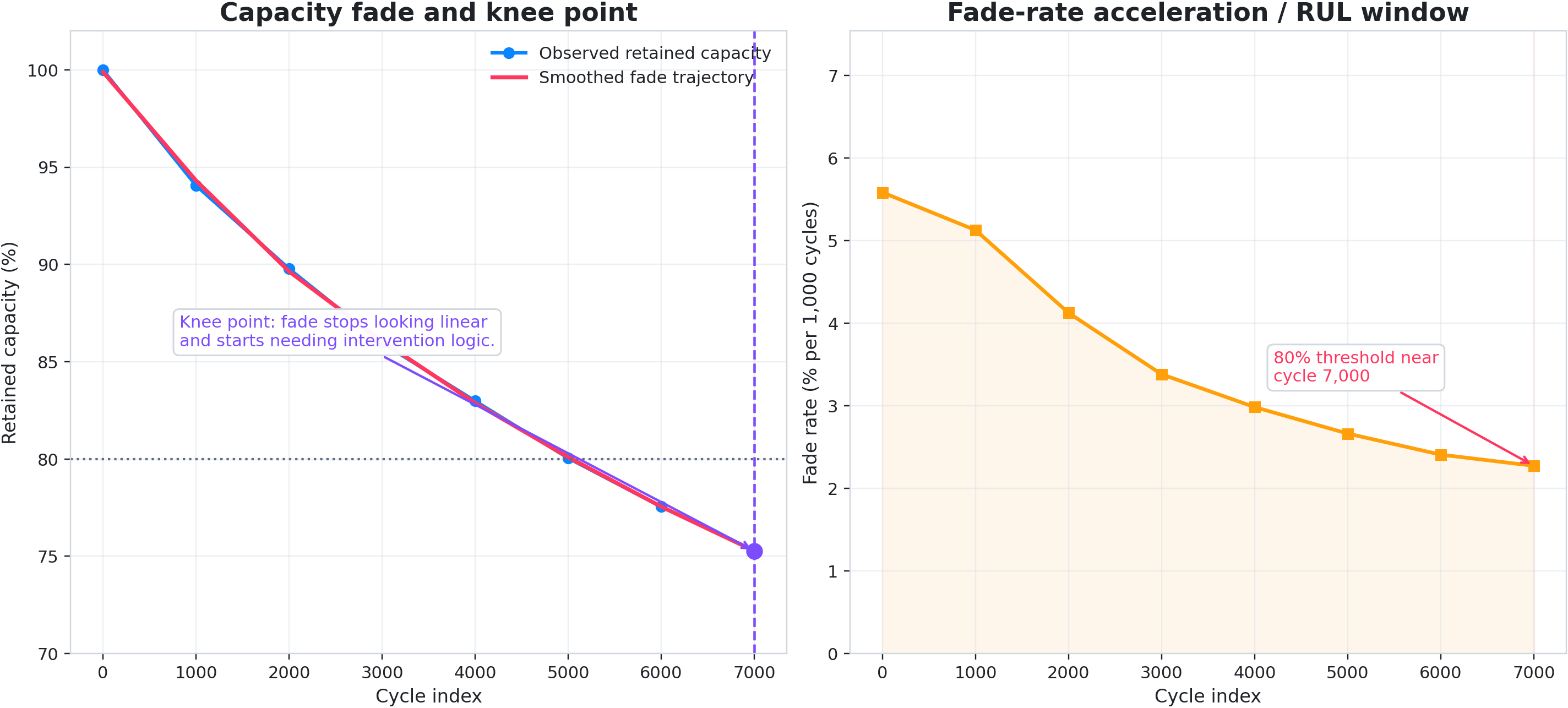
  • Shows where capacity fade stops looking comfortably linear and starts demanding intervention logic.
  • Keeps RUL language bounded and honest instead of turning public charts into fake destiny machines.
  • Bridges directly into augmentation timing, maintenance planning, warranty posture, and dispatch constraint decisions.
Oxford knee-point and remaining useful life chart used on the Oxaide knee-point and RUL method page.

Slow-health evidence stack

Use the full evidence chain when the page is making a predictive-maintenance claim.

The strongest public posture is not one knee chart in isolation. It is slow-health trajectory, knee-point framing, and the operating consequence shown together as one coherent forensic layer.

Predictive maintenance

Knee-point and RUL framing

The cleanest public chart for showing when graceful fade stops being a safe assumption and intervention timing starts to matter.

Dataset anchor

Oxford Battery Degradation Dataset

Evidence reference

Oxford Knee Point Rul

Oxford / health

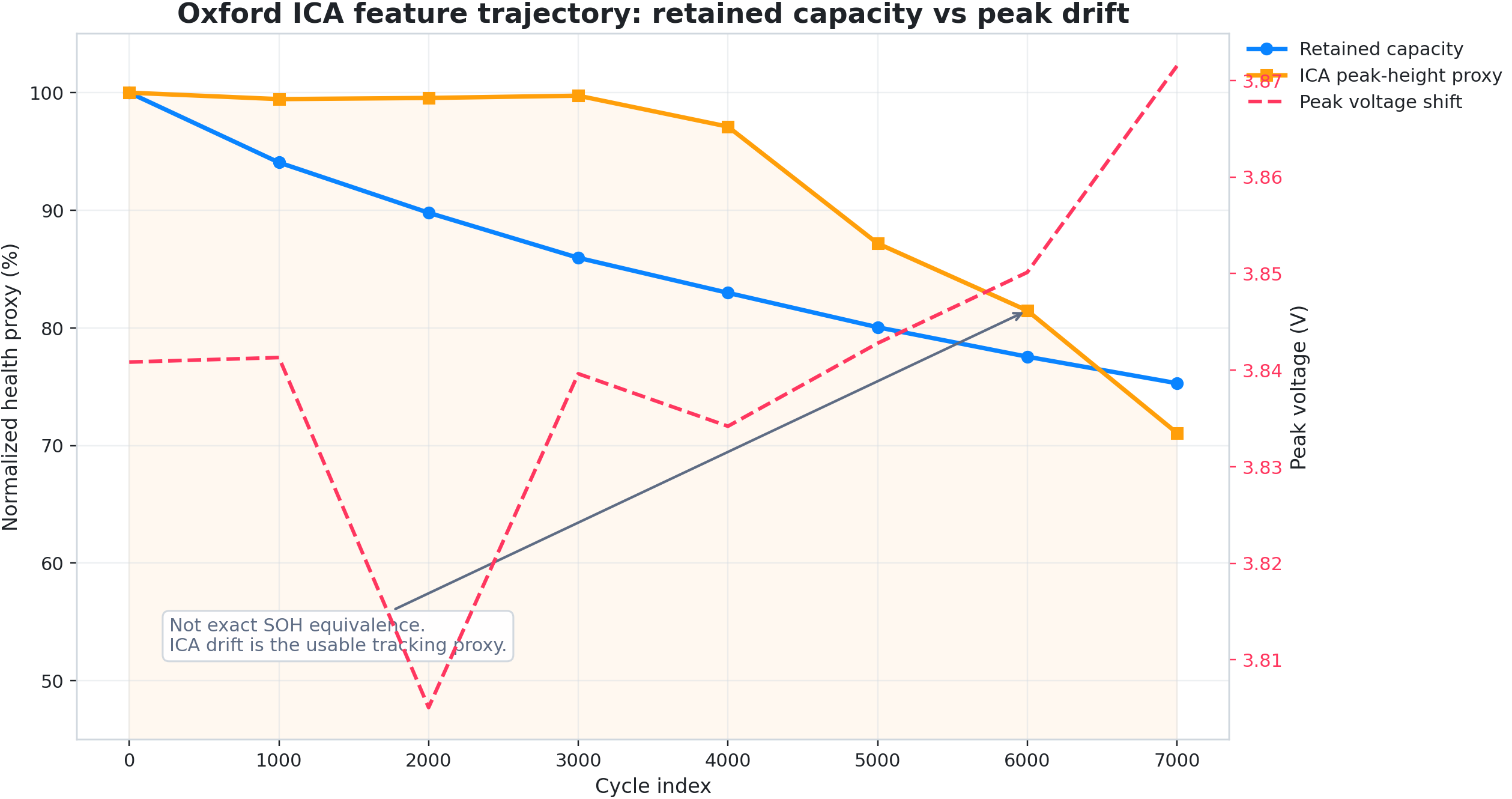
Feature drift into a health trajectory

Knee-point claims are stronger when the underlying chemistry features are shown evolving into a slow-health trajectory rather than staying anecdotal.

Dataset anchor

Oxford Battery Degradation Dataset

Evidence reference

Oxford ICA Soh Proxy

Dispatch / guardrails

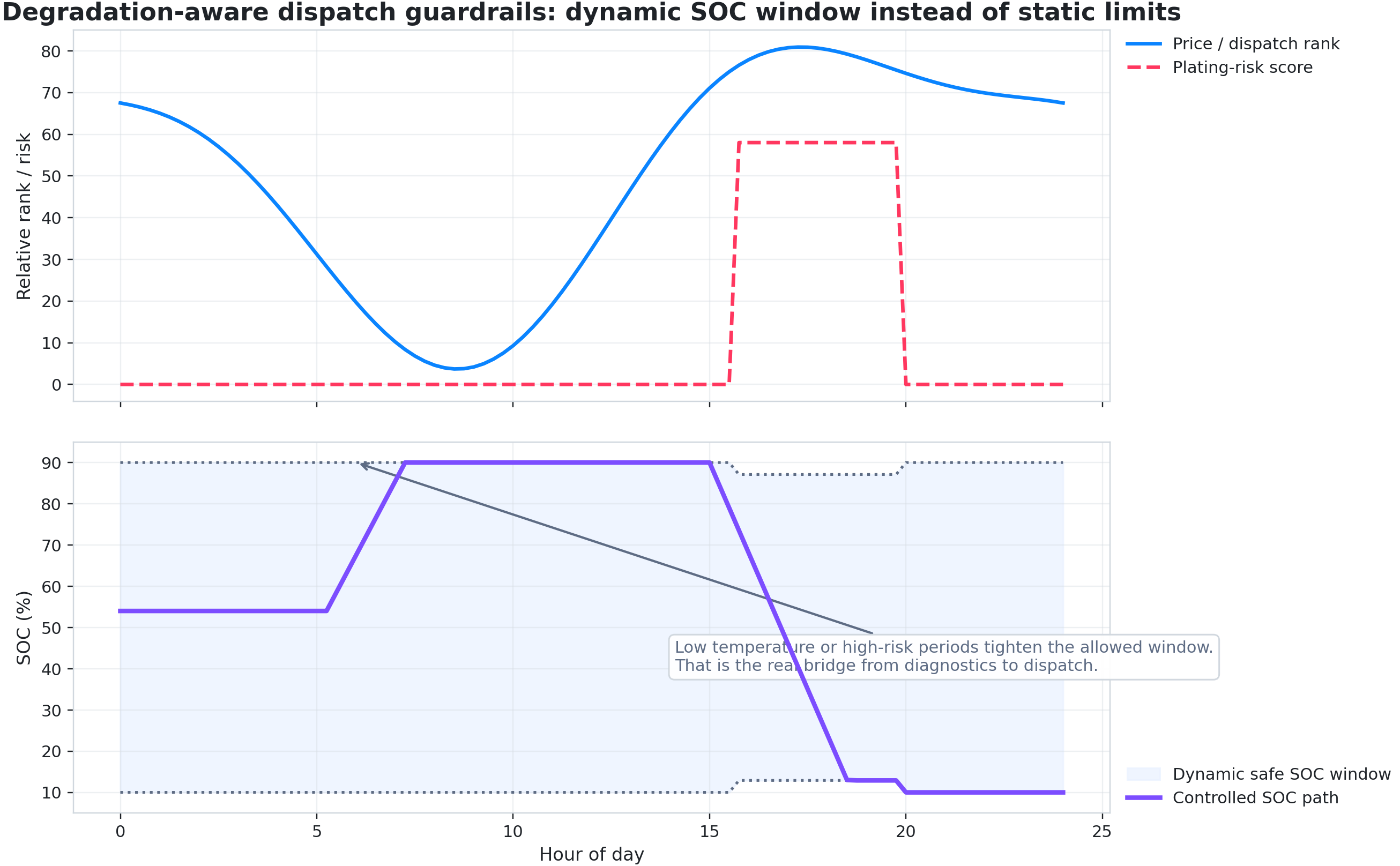
Operating consequence after diagnosis

Predictive maintenance only earns trust when it changes the operating envelope or the intervention queue, not when it stops at a chart caption.

Dataset anchor

Derived public benchmark context

Evidence reference

Dispatch Guardrails

What knee-point means

The point where graceful fade stops being a safe simplifying assumption and the degradation regime starts tightening the runway to an intervention threshold.

What RUL should mean

Bounded runway to a threshold such as augmentation, capacity floor, power limit, or maintenance action, under stated operating assumptions, not as a fake exact date.

Why buyers and owners care

Because acceleration risk changes reserve planning, valuation, warranty posture, and post-close operating confidence before an ordinary dashboard makes the issue obvious.

Buyer-safe framing

Knee-point and RUL work should be handled as slow-health evidence plus intervention timing. The point is not to bluff an exact replacement month. The point is to identify when linear fade is no longer a safe planning story.

That means a serious review will usually combine retained-capacity trend, ICA feature drift, resistance rise, and duty-cycle context before promoting the result into predictive-maintenance language.

The independent forensic layer becomes valuable precisely because it can say: the chemistry is changing, the health trajectory is bending, and the operating or commercial answer should change with it.

Operating posture

Scope first

Defined review scope

Boundary, telemetry window, and mandate question are pinned down before conclusions move.

Encrypted handling

Protected review workflow

Review traffic and operating data are handled with encrypted transfer and controlled access.

Customer boundary

Customer-controlled deployment

Managed, private, and isolated deployment paths are available when the environment requires them.

Direct accountability

Principal sign-off

Technical accountability stays close to the method rather than disappearing into a generic workflow.