
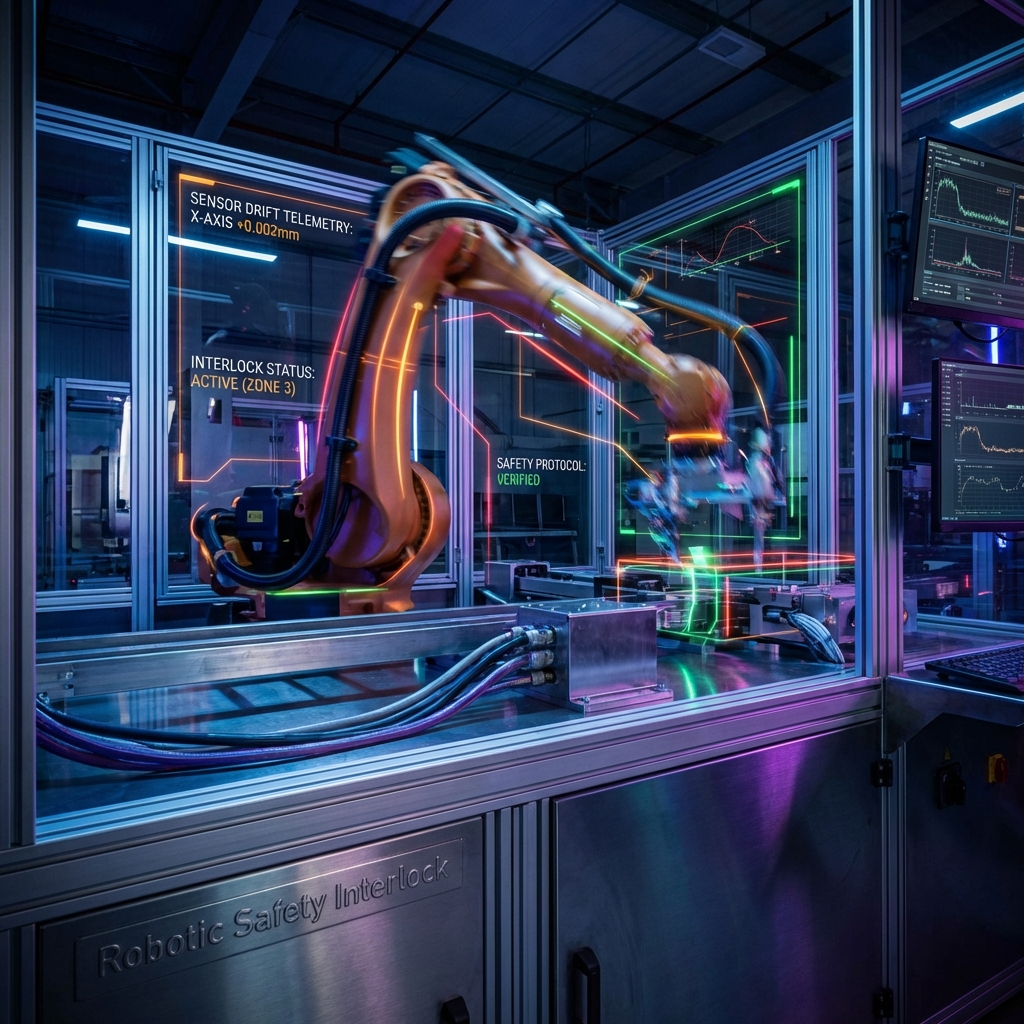
Oxaide Horizon: Robotic Collision Prevention
Deterministic safety masking for automated assembly lines. Detecting mechanical sensor drift at 100Hz to prevent multi-million dollar asset destruction.
Zero
Collisions
Absolute kinetic safety integrity.
100Hz
Monitoring
Positioning sensor sampling rate.
Ideal Deployment Profile
Forensic Field Report
The facility relied on periodic maintenance windows and reactive emergency stops that were often too slow to prevent high-speed kinetic events.
A $2M robotic cell was destroyed due to a $50 sensor drifting out of alignment over a 48-hour period.
Horizon Edge Nodes now monitor every articulation at 100Hz, masking out unsafe movements before they reach the physical threshold of collision.
Operational Infrastructure Profile
Low-latency sensor fusion (SPI/EtherCAT)
Deterministic Rust safety loop (<1ms)
Hardware-level GPIO interlocks
Temporal drift fingerprinting
Technical Friction
& Risk Vectors
Cumulative mechanical wear causing sub-millisecond deviation in robotic positioning
Legacy PLCs lacking the computational bandwidth for high-fidelity safety masking
Production downtime costs exceeding $50k/hour during collision investigation
Engineered Outcome
State
Phased Implementation Step
Continuous drift analysis using high-frequency sensor fusion
Phased Implementation Step
Oxaide Horizon Edge safety interlock (Rust)
Phased Implementation Step
Deterministic hardware-level emergency shutdown triggers
Verified
Strategic Outcomes
Post-deployment verification confirmed the following operational shifts within the target infrastructure.
Request Architecture Review
Discuss how to deploy this Sovereign pattern in your own private, secure environment.