The Enterprise AI Dilemma
For CTOs and CIOs in regulated industries—Family Offices, Private Equity, Legal, and Healthcare—the promise of Retrieval-Augmented Generation (RAG) is irresistible. The ability to chat with your entire corpus of legal documents, investment memos, and historical emails is a transformative productivity multiplier.
But this promise comes with a paralyzing fear: Data Leakage.
When you upload your most sensitive trade secrets to a RAG system, where do they go? Who holds the keys? And importantly, is your data sitting next to your competitor's data on the same server?
In 2026, the market has settled into three distinct deployment models for RAG SaaS. Choosing the wrong one isn't just an IT issue—it's an existential risk.
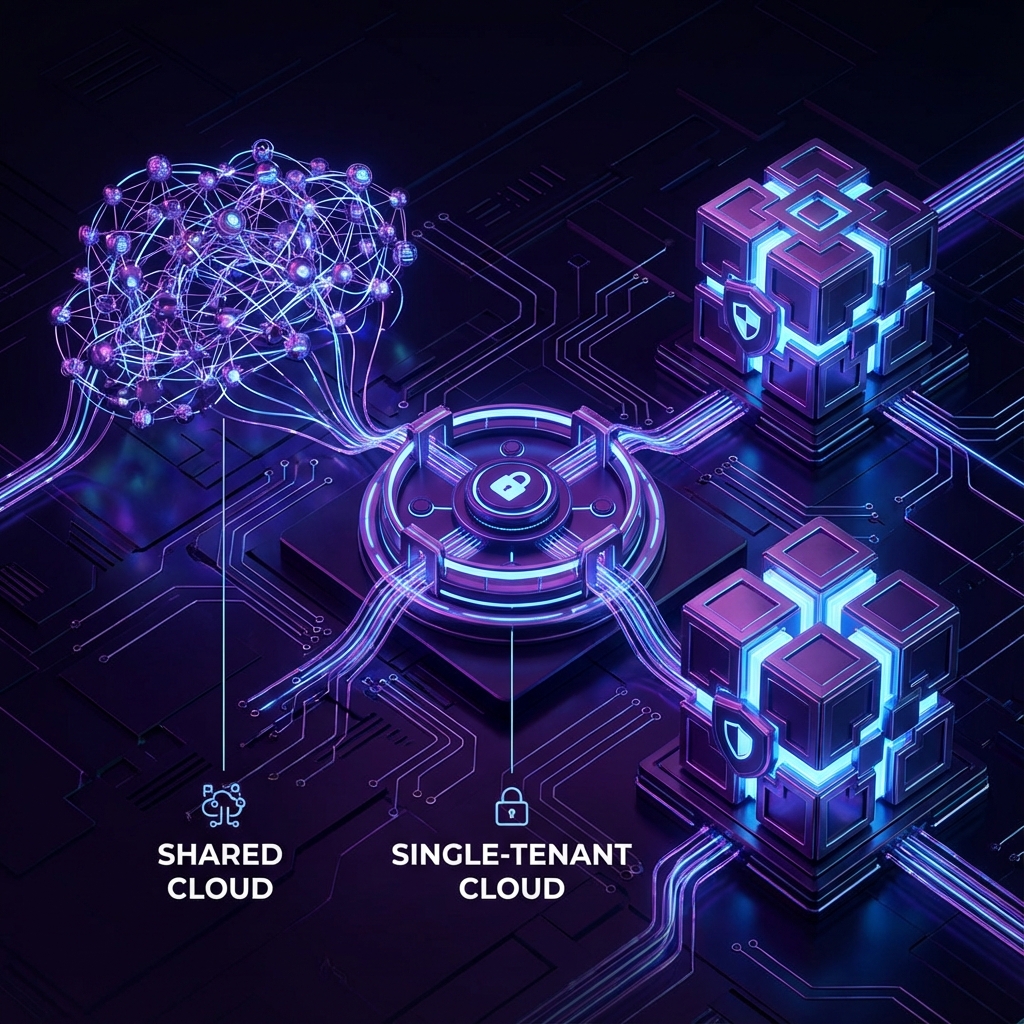
Model 1: Shared Cloud (Public SaaS)
This is the default model for 99% of AI startups. You sign up, get an API key, and start uploading documents.
The "Black Box" Problem
In a shared cloud or multi-tenant architecture, your data lives in a massive, centralized database alongside data from thousands of other companies. Logical separation exists (row-level security in databases), but you are fundamentally sharing the same underlying infrastructure—the same compute nodes, the same memory space, and often the same vector indices.
Vector Database Risks: The "Noisy Neighbor"
Vector databases are the engine of RAG. They convert your text into high-dimensional numbers (vectors). In a shared environment, if the isolation logic has a single bug, or if a sophisticated prompt injection attack manages to "leak" memory context, cross-tenant data exposure is possible.
Verdict: Excellent for public data, marketing copy, and non-sensitive knowledge bases. Fatal for M&A deal flow, family office wealth data, and attorney-client privileged information.
Model 2: Single-Tenant Cloud (The Private Node)
This is the "Sweet Spot" for most modern enterprises. This is Oxaide's "Fast Path" deployment model.
Logical Isolation
In a single-tenant environment, the vendor spins up a completely dedicated set of resources just for you.
- Dedicated Database: Your own Supabase/Postgres instance.
- Dedicated Vector Store: A private index that contains only your vectors.
- Dedicated Compute: Application logic runs on isolated workers.
Even if a catastrophic bug occurred in the vendor's main platform, your data is physically segregated in a different container or virtual private cloud (VPC).
Compliance & Speed
This model satisfies most standard regulatory requirements (like MAS TRM in Singapore or standard GDPR data residency) because you can pin your data to a specific region (e.g., Singapore or Frankfurt) and demonstrate clear isolation.
Verdict: The perfect balance for Law Firms, Engineering consultancies, and general Business Operations. You get the speed of SaaS (deploy in 24 hours) with the security of isolation.
Model 3: On-Premise (The Air-Gap)
This is the "Fortress" approach. This is Oxaide's "Sovereign Box" model.
Physical Isolation
We ship physical hardware—typically a high-performance Apple Silicon (M2/M3 Ultra) Mac Studio or an NVIDIA Jetson/IGX cluster—directly to your office. The RAG system runs entirely on this box.
Zero Egress
We can configure these systems to be Air-Gapped. This means there is no internet connection required for the AI to work. The LLM (like Llama 3) runs locally. The Vector Store runs locally.
- 0 Bytes leave your physical premises.
- 100% Data Sovereignty.
maintenance
Updates are manual and "White Glove". An engineer visits to update the software physically, or you open a secure tunnel for a scheduled maintenance window.
Verdict: Mandatory for Single Family Offices managing billion-dollar portfolios, M&A "War Rooms" handling pre-public deal data, and Defense/Government entities.
Comparative Matrix
| Feature | Shared Cloud (Public) | Single-Tenant (Oxaide Private) | On-Premise (Oxaide Sovereign) |
|---|---|---|---|
| Data Isolation | Logical (Shared DB) | VPC / Container Isolation | Physical Isolation (Air-Gap) |
| Setup Time | Instant | 24 - 48 Hours | 1 - 2 Weeks |
| Cost | Low ($) | Medium ($$) | High ($$$) |
| Maintenance | Auto-Updates | Managed Updates | Manual / Scheduled |
| Latency | Variable | Low (Dedicated Resources) | Ultra-Low (Local Network) |
| Best For | Generic Support | Legal, Engineering, PE | Family Offices, Gov, M&A |
Oxaide's Position
We built Oxaide because we saw a gap. Generic AI tools are too risky for serious business. Custom enterprise building is too slow.
We simply do not offer Shared Cloud for sensitive data.
We start at Single-Tenant. We scale to On-Premise.
If you are a Family Office or Private Equity firm in Singapore, your data is your edge. Don't give it away to a public cloud. Own your intelligence.